
Marlborough Previous Resident Sources
Begin a past-residents search with a current parcel card, then choose the source that reaches the era in question. The Registry provides ownership and instrument history. The Library supplies the historical household layer through its directories, ward lists, resident list, and newspaper microfilm. The Historical Society and the City map collection help reconcile a street or property that looks different in an older source.
| Source | Years it covers | Where held | What it shows |
|---|---|---|---|
| Assessment card | Current assessment system | Marlborough Assessor / AxisGIS | Assessed owner, situs and mailing address, parcel references, values, and deed reference. |
| Recorded-land name index | 1976 to present | Middlesex South MassLandRecords | Grantor, grantee, date, instrument, and book/page or document number. |
| Scanned grantor files | 1896 to 1973 | Middlesex South Registry file directory | Historical grantor-index route to an underlying book/page. |
| City directories | 1867 to 1961, with gaps | Marlborough Public Library | Historical inhabitant, business, address, occupation, and household leads. |
| Ward lists and resident list | Years vary by item | Marlborough Public Library and local election custody | Ward-address context or an alphabetical resident lead. |
| Enterprise microfilm | December 1889 through summer 2022 | Marlborough Public Library | Local news and obituary leads tied to a person or address period. |
The present card is a starting point, not proof of every earlier owner or resident. Move backward only after the parcel, legal description, or book/page reference ties the next item to the same property.
Marlborough Parcel Card Starting Point
Use Marlborough AxisGIS to establish the present assessment key. The City's official card sample includes the property location, owner name and mailing address, map ID, account and alternate parcel IDs, deed reference, GIS ID, assessment values, zoning, use, neighborhood, land measurements, and permit or inspection fields. The dynamic application did not expose a fixed official list of live search labels, so do not assume a current field name or refresh date. Search the exact address, then use the owner, parcel, or map tools the live application displays.
Write down the situs address, mailing address, parcel or map identity, and deed reference separately. A mailing address can point outside the city, and an assessor card is an assessment source rather than a certified title opinion. Those distinctions prevent a researcher from attaching past residents to a management address or from treating a current assessment entry as the full chain of ownership.
Note: Save the parcel or map identity before following a name, because it gives the stable connection between the current card and older instruments.
Marlborough 1896 Grantor Files
Middlesex South now exposes scanned grantor files that cover 1896 through 1973. The official file directory shows groupings from 1896 to 1950 and then narrower files through 1968 to 1973, with a common October 21, 2025 modified timestamp. That opening is especially useful for a Marlborough house history that reaches beyond the current 1976-to-present online name index.
Use the historical index as a route to a document, not as the final answer. Select the appropriate period, use the first-name search only to move near the correct scanned page, inspect neighboring pages, record the book/page, and retrieve the deed or other underlying instrument. Grantor means the person or entity conveying or encumbering an interest; grantee means the person or entity receiving it.
The Middlesex South Registry of Deeds site provides the official office route behind the historical-index work.
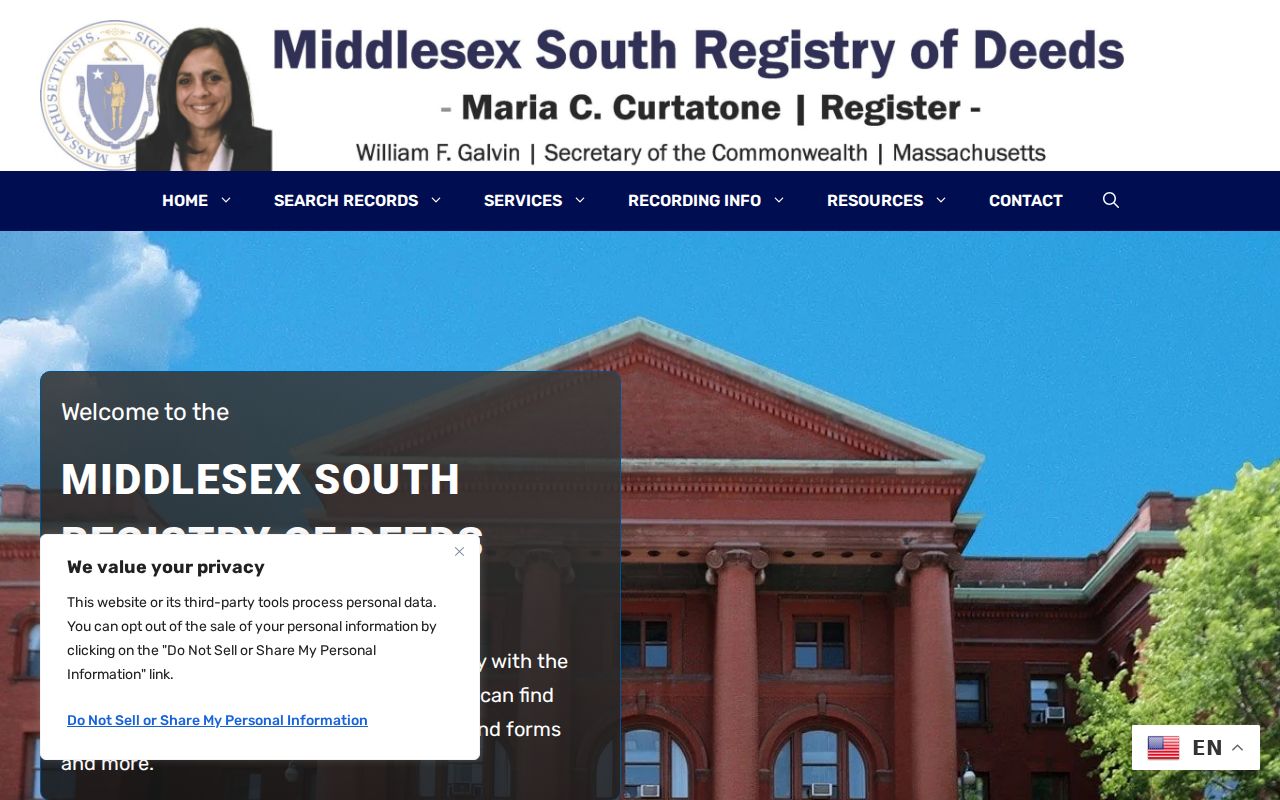
The Registry is also the in-person and phone fallback when a scanned index entry needs an office-level check or a certified copy.
Marlborough Recorded Land Tip
A Marlborough deed reference does not always use the same system. Recorded land is the more common Middlesex form and uses book/page references. Registered land uses the Land Court system, including numbered certificates and document numbers. The Registry FAQ says registered land accounts for about 20 percent of Middlesex County property, so a missing book/page should prompt a check of the registered-land search rather than an assumption that no record exists.
For the 1976 through 1986 interval, repeat a failed deed-only search with document type none
. Registry instructions warn that some imported deed records in that period may carry that label. The same page may also identify mortgages, discharges, liens, plans, easements, municipal lien certificates, tax takings, attachments, executions, and releases, all of which can supply dates or names without proving that a household lived at the address.
Middlesex South Deed Chain
A chain of title is the sequence of recorded transfers and related instruments tied to the same property. Begin with the current assessor owner, but verify the history in the Middlesex South Registry. The Portal supports recorded-land name, document, book, property, date, unindexed-property, and registered-land search modes. Advanced controls can narrow by second party, document type, town, and recorded date. Broad searches may be limited to the first 1,000 results, so combine the owner name with Marlborough and a usable date range.
- Copy the current owner, situs, map or parcel identity, deed reference, and legal description clues from the assessment card.
- Find the acquisition instrument in Middlesex South MassLandRecords, where the current owner should appear as grantee. Record the grantor, date, document type, book/page or document number, and prior-deed reference.
- Search that former owner as grantee to locate the prior acquisition, then repeat the same capture for the next grantor.
- Check connected mortgages, discharges, plans, easements, municipal lien certificates, and other recorded instruments when they clarify the property or its dates.
- When the chain reaches the online cutoff, shift to the scanned grantor and grantee files, then use the book/page to retrieve the underlying record.
- Grantor
- The party giving, selling, or otherwise conveying an interest recorded in an instrument.
- Grantee
- The party receiving the interest. In an acquisition deed, the grantee is the buyer or recipient whose earlier purchase can be searched next.
- Chain of title
- The documented sequence of transactions and related recorded instruments for one property, checked backward from a current reference.
- Legal description
- The lot, plan, metes-and-bounds, or other property description in the instrument. It can be more stable than an old street number.
The recorded and registered land index is the source shown in this search view.
A downloaded image is informational. After finding the exact reference, use the Registry's certified-copy route only when an officially certified copy is needed.
Note: A transfer party can be a trustee or entity, so read the instrument and legal description before linking it to a household.
Marlborough Directories by Address
Owners are only one part of a house history. Marlborough Public Library holds city directories from 1867 through 1961 with missing volumes. A directory entry can contain a surname, given name or initial, occupation or business, residence street, and a household or boarder role. It may omit women, children, boarders, rural households, or people without a listing. Its ward lists are organized by ward address, while its List of Residents is alphabetical by last name.
Use the documented local household flow: copy the address and name from a directory or ward list, compare nearby directory years, search the alphabetical resident list for spelling changes, then review the Marlborough Enterprise microfilm for a dated news or obituary lead. Library access is by reference appointment. Ancestry Library Edition is available inside the Library, and the Library also offers FamilySearch affiliate access, American Ancestors, and Digital Commonwealth links.
The shelf details and entry-reading conventions are kept with the Marlborough city directory collections. For a past-residents trail, those volumes serve as dated household evidence beside the property chain, not as proof of title.
Marlborough Historic Maps and Numbers
Address changes can break a simple name search. Marlborough's historical map resources include 1794, 1803, 1835, 1878, 1900, 1937, 1948, 1956, 1958, and 1962 maps. The Historical Society's five-volume historic-resource survey is searchable and organizes property material by area name and street address, with assessor map/parcel and historic-resource references. It can connect a modern street to a historic architectural description or older district context.
The 1843 Southborough annexation enlarged Marlborough, and the 1866 Hudson boundary change reduced it. A family or property trail can therefore move outside today's city line. No official source found a citywide renumbering date. Compare the maps, ward list, assessor parcel, and deed legal description before changing an old number in research notes.
The Library of Congress identifies a June 1929 Marlborough or Marlboro Sanborn set with 33 sheets, but its catalog says the item is not available online. Sanborn material can help date building form or use when consulted through an available repository; it is not a resident roll.
Note: Search both Marlborough and Marlboro in historic catalogs because the Library of Congress uses both forms in the Sanborn record.
Marlborough Ezra Cutting House Story
House history can uncover records that no index was designed to join. The Marlborough Historical Society describes a local example at the Ezra Cutting House: attic materials found at 22 Pleasant Street in 2005 became a documented Cutting and Bigelow family archive project. The example does not make every attic or old house a source, but it shows why a property trail can extend from parcel and deed references to family papers, maps, photographs, and historical-survey files.
The Marlborough Historical Society property survey offers an address-organized bridge between a street, a historic resource, and assessor map or parcel information. The Society accepts research inquiries and maintains archives of maps, photographs, family papers, books, magazines, and artifacts. Collection cataloging and transcription vary, so cite the item and access route when using a result.
Marlborough Past Household Evidence
When a directory name is found, test it against the records available for that time rather than combining unrelated clues. For previous residents, a ward list offers address-organized context. The alphabetical resident list can reveal a surname or spelling variation. The Enterprise microfilm can add a date or obituary lead. Cemetery transcriptions, local family genealogies, high-school yearbooks, and the Library's historic resources can provide further context. Each is a lead that needs the address and period checked against it.
For an estate or heir question, deeds and Probate and Family Court material may identify fiduciaries, heirs, attorneys, addresses, or property references. Some probate material has restricted or impounded portions, so obtain the permitted file through the appropriate clerk rather than assuming every image is available remotely. A dated directory entry, a historic address, and a recorded deed may all be accurate while describing different moments or roles.
Marlborough Previous Resident Limits
Past-residents research is strongest when it stays tied to a house, family history, estate question, or historical property record. An old address is not proof of a current location, a directory omission is not proof that someone was absent, and a deed party is not necessarily an occupant. Assessment mailing addresses, legal descriptions, and historic street names need to remain separate until the documents connect them.
Middlesex South offers a free property-fraud alert route through the Commonwealth, but an alert does not replace checking an instrument, confirming a Registry reference, or seeking help from the Registry when a record looks wrong. The official Massachusetts property-fraud alert information shows the route for that safeguard.
Use the Registry's official contact route for a suspicious instrument and preserve the document reference when asking for assistance.